The Legionella bacteria is endemic in cooling towers throughout the United States, according to a recent study by the Centers for Disease Control and Prevention (CDC).

The CDC tested water from 196 cooling towers in eight of nine continental U.S. climate regions, and 84 percent returned positive results for Legionella DNA, meaning the bacteria was either present or had been present at some point. Overall, investigators found live Legionella bacteria in 79 cooling towers – half of which had more than one type of Legionella – in most regions of the country.

Legionella bacteria is the cause of the respiratory illness Legionnaires’ disease, a severe – often lethal – form of pneumonia.

The CDC study is the first to illustrate how prevalent Legionella may be in cooling towers, which are known to be a prime culprit in Legionnaires’ disease outbreaks. In two recent and well-publicized outbreaks:

  • Between August and September in 2016, one person died and 23 people were sickened in a Hopkins, MN, outbreak. Officials identified a Citrus Systems, Inc., cooling tower as the source.
  • In 2015, contaminated cooling towers were responsible for the deaths of 12 and more than 120 others becoming infected with Legionnaires’ disease in the South Bronx, NY.

The CDC had previously announced a 286% increase in the number of reported Legionnaires’ cases in the U.S. between 2000 and 2014.
An American Cancer Society (ACS) patient died from complications of contracting Legionnaires’ disease at the ACS’ Hope Lodge in Manhattan in May 2015, according to a lawsuit filed in March. The patient was one of four who took ill with the disease while staying at the housing facility, numerous news sources reported.

Joan Pedersen, 62, had to stop being treated for brain cancer because of the Legionnaires’ disease, which weakened her and prevented her from continuing radiation and chemotherapy treatment. She recovered from the Legionnaires’ disease, but subsequently succumbed to the cancer in May 2015.

According to the lawsuit, the ACS “refused” to install a long-term water-disinfection system for its water supply for months after the Department of Health recommended it do so in late 2015. The ACS finally installed the system in April 2016.

The Hope Lodge provides free housing for cancer patients and their families, who must travel for treatment. There are 30 Hope Lodge locations throughout the United States and Puerto Rico.

The Parisian luxury hotel in Macau, China, has been linked to a possible outbreak of Legionnaires’ disease after three elderly Hong Kong residents were sickened between December 2016 and April, according to multiple news reports.

Macau Health Bureau authorities said two victims have been hospitalized, with one in critical condition and the other in serious condition, and the third has recovered. Two of the men stayed overnight at the hotel, while the third was merely visiting the property.

The Health Bureau ordered Parisian officials to temporarily close the pool, water fountains, and Jacuzzi, as well as to conduct a thorough inspection, cleaning, disinfection, and testing of the water system and possible infected areas. The Health Bureau has completed its testing, and the results are expected back this week.

The $2.7 billion hotel, a five-star resort owned by the Las Vegas Sands, opened September 13, 2016.

The Florida Department of Health has alerted the LA Fitness in Ocoee, a suburb of Orlando, that three gym users have been sickened with Legionnaires’ disease, according to numerous news reports. It has yet to be determined if the infected individuals contracted the disease at the facility, but management is cooperating fully with the investigation by state health officials.

A person catches Legionnaires’ disease – a serious type of pneumonia caused by the Legionella bacteria – by inhaling microscopic water droplets in the form of mist or vapor. The Legionella bacteria are found primarily in human-made, warm-water environments.

The outbreak is the second experienced by an LA Fitness facility in the past six months. In December 2016, two members of a facility in Long Island, NY, were infected with Legionnaires’ disease, and officials shut down the pool, pool area, and spa after water samples showed positive for the Legionella bacteria. One of the infected members filed a $2.5 million lawsuit against the club in March.

A man disabled after contracting Legionnaires’ disease he said was caused by exposure to contaminated water on the job is entitled to workers’ compensation indemnity and medical benefits, a Pennsylvania appellate court ruled in late March.

Business Insurance – a publication of Crain Communications — reported that in June 2013, Shawn Gallen of Nestle USA Inc. experienced flu-like systems and sought treatment at a hospital, where he was diagnosed with Legionnaires’ Disease. The illness affected Gallen’s speech and left him in a wheelchair and needing assistance.

Gallen sued Nestle in September 2013, saying he was infected while working on machines that contained contaminated water. According to court records, Nestle denied the allegations and said Gallen could not prove the disease was a result of work-related exposure.

A workers’ comp judge, however, ruled after hearing testimony that Gallen’s illness likely was caused by exposure on the job. The judge determined that Gallen was temporarily totally disabled and entitled to workers’ comp benefits, and the state’s Workers’ Compensation Appeal Board affirmed that decision, court documents show. Nestle filed an appeal, but a three-judge panel of the Commonwealth Court of Pennsylvania unanimously upheld the judge’s decision.

The Centers for Disease Control and Prevention (CDC) reported in June 2016 that the number of Legionnaires’ disease cases that were recorded in the United States between the years 2000 and 2014 more than quadrupled, increasing from 1,127 to 5,166.* Outbreaks both big and small are becoming more frequent on a yearly basis, as evidenced by these reports from 2016:

  • January: A Fresno, CA, nursing home resident died after contracting Legionnaires’ disease.
  • February: An individual case of Legionnaires’ disease was reported in Moravia, NY, at the Mill Stream Court Apartments.
  • May: The Hawaii Department of Health investigated one possible and two confirmed cases of Legionnaires’ disease in guests who stayed at a hotel in Kapaa in late April to early May. Both confirmed victims recovered.
  • June: Two people were diagnosed with Legionnaires’ disease after staying at a condominium resort in Ocean City, MD. The resort had installed a water disinfection system in April because two other guests had been diagnosed with the disease after staying there in October 2015, but the Legionella bacteria was still discovered in the water system. … Three guests at a hotel in Blowing Rock, NC, were diagnosed with Legionnaires’ disease between April 15 and June 15, and all three were hospitalized. … Four residents of a personal-care home in Middletown, PA, tested positive for Legionella, and one died.
  • July: Two cases of Legionnaires’ disease were confirmed at an apartment complex in West Harlem, NY. (Note: The announcement came less than a year after New York City’s largest Legionnaires’ disease outbreak occurred in the south Bronx, infecting 108 and killing 10.)
  • August: Two residents of the Ussery-Roan Veterans Home in Amarillo, TX, contracted Legionnaires’ disease. Both recovered.
  • September: Twenty-three cases – including one fatality – were reported in Hopkins, MN, and were attributed to a cooling tower at Citrus Systems, Inc. … An outbreak of Legionnaires’ disease infected four patients at the University of Washington Medical Center in Seattle, resulting in the death of two. A 32-year-old woman who recovered sued the hospital. … In Marietta, GA, four cases of Legionnaires’ disease were reported at Cobb Lockheed Martin’s facility, confirmed over the course of a year.
  • October: Six individuals from Chaves County in New Mexico were confirmed with Legionnaires’ disease, and two of the victims died. No cause of the outbreak was determined. … Eight cases of Legionnaires’ disease were reported at the La Quinta Inn in Memphis, TN.
  • December: An LA Fitness in Long Island, NY, temporarily closed its pool and spa for testing and remediation after two members were diagnosed with Legionnaires’ disease. Both victims recovered.

Incidents of Legionnaires’ disease typically rise during warmer weather, but as this list shows, the disease has become a year-round problem. Perhaps the tide can be stemmed in 2017.

* The number of actual cases of Legionnaires’ disease is thought to be about 25,000 per year, simply because of the preponderance of unreported cases, which are due primarily to the nonspecific signs and symptoms. According to medscape.com, accurate data is not available due to the “underutilization of diagnostic testing.”

Sources: hcinfo.com, CDC.com, legionella.org, mayoclinic.org, medscape.com

Legionnaires’ disease is one of those illnesses that usually has people scratching their heads. Most don’t understand what the disease is, or what it does to victims. That, however, is starting to change, as the disease becomes more commonplace and newsworthy.

Here are some frequently asked questions – and their corresponding answers – about Legionnaires’ disease:

What is Legionnaires’ disease? Legionnaires’ disease – also called Legionellosis and Legionella pneumonia – is a severe type of pneumonia or lung infection. According to the Centers for Disease Control and Prevention (CDC), health departments reported nearly 10,000 cases of Legionnaires’ disease in the United States in 2018. Because the disease is underdiagnosed, this number is more likely to be 2.5 times greater. In any case, 10 percent of those infected will die from the infection.

How do you contract Legionnaires’ disease? Legionella bacteria are contracted by inhaling microscopic water droplets in the form of mist or vapor. The bacteria grow best in warm water and are found primarily in human-made environments. Outbreaks have been linked to a range of sources, such as:

  • cooling towers in air conditioning systems
  • decorative fountains
  • mist machines in grocery stores’ produce sections
  • hot tubs and whirlpools at fitness centers and on cruise ships
  • hot water tanks and heaters
  • large plumbing systems
  • showers and faucets
  • swimming pools
  • equipment used in physical therapy
  • water systems like those used in hotels, hospitals, and nursing homes.

People also can catch Legionnaires’ disease by the aspiration – a condition in which food, liquids, saliva, or vomit is inhaled into the airways – of contaminated drinking water. It’s also possible to contract Legionnaires’ disease from home plumbing systems, although the great majority of outbreaks have occurred in large buildings, because complex systems allow the bacteria to grow and spread more easily.

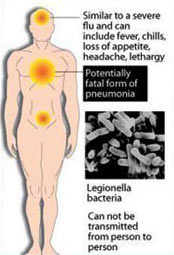
How is LeLD2_AFPgionnaires’ disease diagnosed? The symptoms of Legionnaires’ disease look like other forms of pneumonia or even the flu, which is why so many cases go unreported. Early symptoms can include:

  • chills
  • fever (potentially 104 degrees or higher)
  • headaches
  • loss of appetite
  • muscle aches.

After the first few days of the disease presenting, symptoms can worsen to include:

  • chest pain when breathing (called pleuritic chest pain, due to inflamed lungs)
  • confusion and agitation
  • a cough, which may bring up mucus and/or blood
  • diarrhea (about one-third of all cases result in gastrointestinal problems)
  • nausea and vomiting
  • shortness of breath.

The incubation period – the amount of time between breathing in the bacteria and developing symptoms – is usually 2 to 10 days after exposure and can be as much as 16 days. On average, however, the incubation period is 3 to 6 days.

(Note: There is also a mild form of Legionnaires’ disease called Pontiac fever, which can produce symptoms including a fever, chills, headache, and muscle aches. Pontiac fever doesn’t infect the lungs, however, and symptoms usually disappear within two to five days.)

What are the complications of Legionnaires’ disease? After Legionnaires’ disease has been diagnosed, hospitalization is often necessary. In the most severe cases of Legionnaires’ disease, complications can include respiratory failure, kidney failure, septic shock, or even death.

Are you at risk of contracting the disease? Anyone can get the disease, but those at the greatest risk of infection include:

  • people 50 years old or older
  • smokers (current or former)
  • heavy drinkers of alcohol
  • people with chronic lung disease, such as chronic obstructive pulmonary disease or emphysema
  • people with weakened immune systems (those suffering from diseases such as diabetes, cancer, kidney failure, or infected with HIV)
  • organ-transplant recipients
  • individuals following certain drug protocols (for instance, corticosteroids)

Even relatively healthy individuals have been known to contract the disease, although less typically.

Why is it called Legionnaires’ disease? In July 1976, more than 4,000 delegates to the American Legion Convention gathered at Philadelphia’s Bellevue-Stratford Hotel. Several days after the four-day event, many attendees became sick. By Aug. 2, more than 20 attendees were dead, and hundreds were experiencing pneumonia-like symptoms. The final case count reached 221, and 34 of those died.

It wasn’t until months later that the bacterium was identified and isolated and found to be breeding in the cooling tower of the hotel’s air conditioning system.

Sources: CDC.com, epa.gov, osha.gov, eddmprnews.org, legionella.org, mayoclinic.org, patient.info, hcinfo.com, healthline.com, medscape.com

Image: Agence France-Presse