Another resident has taken ill with Legionnaires’ disease at the Illinois Veterans Home in Quincy (IVHQ), a month after two residents were sickened with the disease, according to a Nov. 28 news release from the Illinois Department of Health.

The illnesses come two years after a 2015 outbreak at the IVHQ in which 12 people died and 53 others were sickened.

The resident was diagnosed while being treated at a local hospital over the weekend and has since been released. One of the two individuals sickened last month died.

The IVHQ undertook a nearly $5 million, state-of-the-art rehabilitation of its water-treatment plant in summer 2016. There were four cases of Legionnaires’ disease at the facility in 2016, including three after the rehabbed plant was made operational.

Dave MacDonna, an Illinois Department of Veterans’ Affairs spokesperson, believes the spike in Legionnaires’ diagnoses could be due, in part, to the increase in testing for the pneumonia-like disease. Illinois experiences about 300 cases each year.

McDonna said the home was in a state of “high alert,” and any resident displaying symptoms is tested regularly and hospitalized if symptoms persist.

Legionnaires’ disease symptoms 

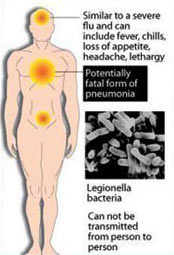
Legionnaires’ disease looks like other forms of pneumonia or even flu, which is why so many cases go unreported every year. Early symptoms can include:

  • chills
  • fever, which can be 104 degrees or higher
  • headaches
  • loss of appetite
  • muscle aches.

After the first few days, symptoms can worsen to include:

  • chest pain when breathing, called pleuritic chest pain (due to inflamed lungs)
  • confusion and agitation
  • a cough, which may bring up mucus and blood
  • diarrhea (about one-third of all cases result in gastrointestinal problems)
  • nausea and vomiting
  • shortness of breath.

The incubation period – the amount of time between contracting the bacteria and developing symptoms – is usually 2 to 10 days. However, it can be as much as 16 days.

Who is at risk? 

Anyone can get the disease, but those at higher risk of infection include:

  • people 50 or older
  • current or former smokers
  • heavy drinkers of alcohol
  • people with chronic lung disease
  • people with suppressed immune systems
  • organ-transplant recipients
  • people who are following specific drug protocols (corticosteroids, for example).

(Photo credit: Michael Kipley / Quincy Herald-Whig via The Associated Press)

While the Legionnaires’ disease outbreak at Disneyland has dominated the news cycle, other Legionnaires’ disease cases have popped up across the country:

  • In northern California: A Sonoma County woman died recently from Legionnaires’ disease, the Sonoma County Public Health department announced Nov. 27. The case – the fourth in the county this year – is the first reported death due to Legionnaires’ disease in 2017. None of this year’s four cases involved a common source. The county usually documents fewer than 10 cases a year; in 2016, eight cases were reported.
  • In the Midwest: A case of Legionnaires’ disease was confirmed in the Kansas City metro area, according to KCTV5. A woman sickened with Legionnaires’ disease has been in a medically induced coma for two weeks. She underwent surgery today at Liberty (MO) Hospital, according to family members. Those family members said she may have contracted the disease while working at the Ford Plant in Claycomo, but no confirmed source has been identified by local health officials.
  • In the East: A resident of Beechtree Commons, a senior housing community in Penn Hills, PA, was confirmed with Legionnaires’ disease on Nov. 2, according to the Allegheny County Health Department. Tests conducted on the water system were negative for Legionella at the two-building complex, which houses about 100. It is unknown where the resident became infected.

Case count increases across U.S.

Legionnaires’ disease is a severe type of pneumonia or lung infection. It is “an emerging disease in the sense that the number of recorded cases of Legionnaires’ in the United States continues to increase,” said Laura Cooley, MD, MPH from the Respiratory Diseases Branch of the Centers for Disease Control and Prevention (CDC).

Cooley said she believes the increase is due to a rise in the susceptibility of the population, with more and more people on immunosuppressive medications. In addition, there could be more Legionella in the environment, with warmer temperatures creating the right conditions for bacterial growth.

About 25,000 cases annually

The CDC estimates that 25,000 cases of Legionnaires’ disease occur in the U.S. yearly. Only 5,000 cases are reported, however, because of the disease’s non-specific signs and symptoms.

Legionella bacteria are contracted by inhaling microscopic water droplets in the form of mist or vapor. The bacteria, which thrive in warm water, are found primarily in human-made environments, such as cooling towers and air-conditioning systems, to name just a couple.

Cases are more commonly reported during the summer and early fall but can happen any time of the year, as illustrated by these recent reports.

The Southern Nevada Health District announced that the number of confirmed Legionnaires’ disease cases has risen to seven – with 29 more cases suspected – five months after an outbreak was originally reported at the Rio All-Suite Hotel and Casino in Las Vegas.

In addition, there were 56 suspected cases of Pontiac fever, which is a flu-like illness caused by Legionella bacteria. Unlike Legionnaires’ disease, Pontiac fever does not cause pneumonia (see below). Those 56 cases bring the total count to 92 confirmed or suspected cases related to the outbreak.

In June, two visitors contracted Legionnaires’ disease after staying at the hotel separately in March and April. Testing of the hotel’s hot-water system in May confirmed the presence of Legionella, which is the bacteria that causes Legionnaires’ disease.

Legionnaires' disease
Legionnaires’ disease basics

“The health district continued to receive notifications of the illnesses from hotel guests who left Las Vegas and were diagnosed in their hometowns,” according to Kimberly Hertin, the SNHD surveillance supervisor.

Cleaning and monitoring the hotel’s water system is ongoing to ensure the eradication of Legionella. All recent tests of the hotel’s water systems showed low levels or no presence of Legionella. A third disinfection took place Nov. 3 as a precaution.

“Guests are not currently at risk for infection,” according to Robert Cole, the SNHD senior environmental health specialist.

“The entire Rio property is open and we have remediated all water sources,” the Rio released in a statement Wednesday. “We continue to work with the Southern Nevada Health Department and have taken the additional step of voluntarily installing a new filtration system to help prevent a reoccurrence.”

Legionnaires’ or Pontiac fever?

Legionnaires’ disease – also called Legionellosis and Legionella pneumonia – is a severe type of pneumonia or lung infection. According to the Centers for Disease Control and Prevention (CDC), an estimated 25,000 cases of pneumonia due to the Legionella bacteria (Legionella pneumophila) occur each year, but only 5,000 cases are reported because of the disease’s non-specific signs and symptoms. In addition, 10 percent of those cases will end in death.

Pontiac fever, on the other hand, can produce symptoms including a fever, chills, headache, and muscle aches. Pontiac fever, however, doesn’t infect the lungs.

Legionella in the air 

Legionella bacteria are contracted by inhaling microscopic water droplets, generally in the form of mist or vapor. The bacteria, which grow best in warm water, are found primarily in human-made environments.

Outbreaks have been linked to a range of sources, such as:

  • water systems, such as those used in hotels
  • cooling towers in air-conditioning systems
  • decorative fountains
  • mist machines
  • hot tubs/whirlpools
  • hot-water tanks and heaters
  • large plumbing systems
  • showers and faucets
  • swimming pools.

Another person is dead, and three additional cases been linked to the Anaheim Legionnaires’ disease outbreak, it was announced Wednesday by the Orange County Health Care Agency (HCA).

Two of the three new cases involved individuals who visited Disneyland. Of the 15 cases, 11 involved people who visited Disneyland in September, including one who worked there.

Thirteen of the 15 patients were hospitalized and the two who died both had underlying health problems that made them more susceptible to complications, Neither individual who died visited Disneyland.

No additional information was made available on the two individuals who passed away.

Cooling towers at Disneyland were shut down after Dr. Eric Handler, the county’s Health Officer, issued an order Nov. 8 requiring Disney to take the towers out of service until the park can ensure they are free of contamination. Elevated levels of Legionella bacteria, which is the bacteria that causes Legionnaires’ disease, were found in them after testing in October.

Recent water samples collected Nov. 2 and Nov. 6 were negative for the bacteria, according to Disneyland officials. The water in the towers was sanitized Nov. 4.

“Negative results mean that the towers do not pose a current ongoing risk for transmission of Legionella,” HCA spokesperson Jessica Good said, adding that the agency is working with Disney on procedures to bring the towers back into operation.

Those procedures include making sure cleaning and sanitation are done according to guidelines set forth by the American Society of Heating, Refrigerating and Air-Conditioning Engineers, and the Cooling Technology Institute. Disney must also provide a plan to clean, maintain and monitor all of its cooling towers for bacteria.

The cooling towers will reopen after all the criteria have been satisfied.

Good said the majority of patients having visited Disneyland “indicates a pattern but does not identify that specific location as the common source of infection for all cases.”

Health officials continue to search for the source, according to Good. They’re visiting hotels, motels, and businesses that aren’t associated with the Disneyland Resort along the Harbor Boulevard corridor to see if they can find any connection to the illnesses.

The 15 cases were reported to the HCA between Sept. 27 and Nov. 15 and involved individuals whose ages ranged from 52 to 94 years old. All were infected before the cooling towers were shut down.

Cooling towers hot spots for Legionella

The Legionella bacteria is endemic in cooling towers throughout the United States, according to a recent study by the Centers for Disease Control and Prevention (CDC).

The CDC tested water from 196 cooling towers in eight of nine continental U.S. climate regions, and 84 percent returned positive results for Legionella DNA, meaning the bacteria were either present or had been present at some point. Overall, investigators found live Legionella bacteria in 79 cooling towers – half of which had more than one type of Legionella – in most regions of the country.

The CDC study is the first to illustrate how prevalent Legionella may be in cooling towers, which are known to be a prime culprit in Legionnaires’ disease outbreaks. In two recent and well-publicized outbreaks:

  • Between August and September in 2016, one person died and 23 people were sickened in a Hopkins, MN, outbreak. Officials identified a Citrus Systems, Inc., cooling tower as the source.
  • In 2015, contaminated cooling towers were responsible for the deaths of 12 and more than 120 others becoming infected with Legionnaires’ disease in the South Bronx, NY.

The CDC had previously announced a 286 percent increase in the number of reported Legionnaires’ cases in the U.S. between 2000 and 2014.

The J.M. Tull Gwinnett Family YMCA in Lawrenceville, GA, temporarily closed its pool, hot tubs, sauna, steam room and shower areas last week because of the potential for Legionella bacteria infection, according to multiple news outlets. All other areas of the suburban Atlanta facility remained open to the public.

Legionella is the bacteria that causes Legionnaires’ disease or Legionellosis, a respiratory illness that can result in death.

The Gwinnett County Health Department alerted the YMCA about multiple cases of Legionella involving people who had used the facilities, which prompted the closures. It’s unknown how many visitors reported health issues.

“Based on information provided by the health department, we immediately closed the potential areas of concern,” the YMCA wrote in a letter to members. “Although there are currently no environmental samples showing this bacteria is present in our facility, we are taking every precaution and have hired an outside company who specializes in remediation for public facilities.”

Remediation is performed to reverse or stop environmental damage. Remediation consists of cleaning, heat treating, and hyper-chlorinating the water tanks and water systems, and can include the addition of filters to showers, faucets, and hoses.

Members, recent visitors or employees of the club who may be exhibiting symptoms of Legionellosis should immediately contact their physicians for care. They should also call the Gwinnett County Health Department at 770-339-4260 and report their symptoms to the epidemiologist.

Legionnaires' disease bacteria
Legionella bacteria

What are the symptoms? 

Legionnaires’ disease looks like other forms of pneumonia or even the flu, which is why so many cases go unreported every year. Early symptoms can include the following:

  • chills
  • fever (can be 104 degrees or higher)
  • headaches
  • loss of appetite
  • muscle aches.

After the first few days, symptoms can worsen to include:

  • chest pain when breathing, called pleuritic chest pain (due to inflamed lungs)
  • confusion and agitation
  • a cough, which may bring up mucus and blood
  • diarrhea (about one-third of all cases result in gastrointestinal problems)
  • nausea and vomiting
  • shortness of breath.

The incubation period – the amount of time between contracting the bacteria and developing symptoms – is usually 2 to 10 days and can be as much as 16 days.

Are you at risk of contracting Legionnaires’? 

Anyone can get the disease, but those at higher risk of infection include:

  • people 50 years old or older
  • smokers (current or former)
  • heavy drinkers of alcoholic beverages
  • people with chronic lung disease
  • people with weakened immune systems
  • organ-transplant recipients
  • individuals following specific drug protocols (for example, corticosteroids).

The Orange County Health Care Agency (HCA) is investigating 12 cases of Legionnaires’ disease in the Anaheim area, including the death of one person, according to news reports. Nine of those sickened had visited Disneyland in September, before developing the serious respiratory illness, including one Disneyland employee.

The three individuals who took ill who had not visited the park were Orange County residents who lived or traveled in the Anaheim area. Ten of the 12 needed to be hospitalized; their ages ranged from 52 to 94 years old.

The individual who died had not visited Disneyland but had additional health problems that made them more susceptible to complications, officials said.

A common source for the illnesses have yet to be identified, but the resort voluntarily shut down two cooling towers in the theme park after elevated levels of Legionella bacteria were found in them after testing in October.

“We conducted a review and learned that two cooling towers had elevated levels of Legionella bacteria,” said Dr. Pamela Hymel, chief medical officer for Walt Disney Parks and Resorts, in a statement. “These towers were treated with chemicals that destroy the bacteria and are currently shut down.”

New Orleans Square Train Station at Disneyland

The towers are in a backstage area near the New Orleans Square Train Station, about 100 feet from areas accessible to guests.

The HCA informed Disney of the Legionnaires’ cases on Oct. 27. Hymel added that “there is no longer any known risk associated with our facilities.”

A disease on the rise in U.S.

Legionnaires’ disease is a severe type of pneumonia or lung infection and is “an emerging disease in the sense that the number of recorded cases of Legionnaires’ in the United States continues to increase,” according to Laura Cooley, MD, MPH from the Respiratory Diseases Branch of the Centers for Disease Control and Prevention (CDC).

Cooley said she believes the increase is due to an increase in the susceptibility of the population, with more and more people on immunosuppressive medications. In addition, there could be more Legionella in the environment, with warmer temperatures creating the right conditions for bacterial growth.

How do you catch Legionnaires’? 

Legionella bacteria are contracted by inhaling microscopic water droplets in the form of mist or vapor. The bacteria, which grow best in warm water, are found primarily in human-made environments. Outbreaks have been linked to a range of sources, such as:

  • cooling towers in air conditioning systems
  • decorative fountains
  • hot tubs and whirlpools
  • hot water tanks and heaters
  • large plumbing systems
  • showers and faucets
  • swimming pools.

What are the symptoms?

The symptoms of Legionnaires’ disease are similar to other forms of pneumonia or even flu, which is why so many cases go unreported. Early symptoms can include:

  • chills
  • fever, potentially 104 degrees or higher
  • headaches
  • loss of appetite
  • muscle aches.

After the first few days, symptoms can worsen to include:

  • chest pain when breathing (called pleuritic chest pain, due to inflamed lungs)
  • confusion and agitation
  • a cough, which may bring up mucus and blood
  • diarrhea (about one-third of all cases result in gastrointestinal problems)
  • nausea and vomiting
  • shortness of breath.

The incubation period – the amount of time between breathing in the bacteria and developing symptoms – is usually 2 to 10 days after exposure and can be as much as 16 days.

Who should be most concerned?

After Legionnaires’ disease has been diagnosed, hospitalization is often necessary. In the most severe cases, complications can include respiratory failure, kidney failure, septic shock, or even death.

Anyone can get the disease, but those at the greatest risk include:

  • people 50 or older
  • smokers, current or former
  • heavy drinkers of alcoholic beverages
  • people with chronic lung disease
  • people with weakened immune systems.

Five people have contracted Legionnaires’ disease at an elderly care facility in the Bronx, NY, the New York City Department of Health and Mental Hygiene (DOHMH) has confirmed.

The five, all residents of the Hebrew Home at Riverdale, were diagnosed with pneumonia last month and subsequently tested positive for Legionella bacteria, which is the bacteria that causes Legionnaires’ disease.

The individuals infected in this outbreak are recovering after being treated with antibiotics, according to a Hebrew Home representative.

Facility opened 100 years ago 

The healthy-aging facility was founded a century ago in 1917 as The Hebrew Home for the Aged by a small synagogue in Harlem and moved to its current location at 5901 Palisade Avenue in Riverdale, NY, in 1951. The 32-acre RiverSpring Health campus along the Hudson River is home to more than 12,000 residents, patients, and members.

What is Legionnaires’ disease? 

Legionnaires’ disease – which is also known as Legionellosis and Legionella pneumonia – is a severe type of pneumonia (lung infection). According to the Centers for Disease Control and Prevention (CDC), an estimated 25,000 cases of pneumonia due to the Legionella bacteria (Legionella pneumophila) occur each year, but only 5,000 cases are reported because of the disease’s nonspecific signs and symptoms.

The CDC estimates 1 in 10 people will die from complications of the infection. The odds are even worse for individuals who take ill at health care facilities – 1 in 4 will succumb to the disease.

How do you catch Legionnaires’ disease? 

The Legionella bacteria are contracted by inhaling microscopic water droplets in the form of mist or vapor. The bacteria, which grow best in warm water, are found primarily in human-made environments. Outbreaks have been linked to a range of sources, such as:

  • cooling towers in air conditioning systems
  • decorative fountains
  • hot tubs and whirlpools
  • hot water tanks and heaters
  • large plumbing systems
  • showers and faucets
  • swimming pools
  • equipment used in physical therapy
  • water systems like those used in hospitals, and nursing homes.

People can also catch Legionnaires’ disease by the aspiration of contaminated drinking water – that is, choking or coughing while drinking can cause water to go down the wrong pipe into the lungs. It’s also possible to contract Legionnaires’ disease from home plumbing systems, although the great majority of outbreaks have occurred in large buildings because complex systems allow the bacteria to grow and spread more easily.

Update, Nov. 3
One of the two residents sickened with Legionnaires’ disease at Sky View Rehabilitation & Health Care in Croton-on-Hudson, NY, has died, authorities announced Thursday. Carmella Scafuri, 93, passed away Tuesday. The other resident is still receiving care.

Original post, Oct. 31
Legionnaires’ disease has been confirmed in two residents of Sky View Rehabilitation & Health Care in Croton-on-Hudson, a village in Westchester County, NY, according to news reports.

Both residents were initially diagnosed with pneumonia before additional testing indicated their illnesses to be the more serious respiratory disease, Legionnaires’ disease. The first resident was diagnosed Oct. 18, the second Oct. 27.

A Sky View official said the pair are receiving “appropriate medical care.”

Earlier this summer, a water sample taken at the facility was positive for Legionella bacteria, which causes Legionnaires’ disease. The facility is required to test the water system every quarter to comply with state health regulations. An aggressive flushing program was implemented, according to Westchester County Executive Rob Astorino, and subsequent water tests in August and September were clear of Legionella.

“We are extremely concerned by these cases,” said Vincent A. Maniscalco, the center’s administrator. “We are taking all necessary steps to protect our residents, staff, and visitors.”

As a precaution, the facility is screening all residents for respiratory symptoms, and a water safety consultant has been retained to remediate the facility and eliminate the spread of the disease.

The New York State Health Department is in charge of the investigation, along with the assistance of the Westchester County Department of Health. The investigation will focus on the water system and any equipment where water collects, pools, sprays or mists, such as drinking fountains, showers, tubs or hoses.

The rehab center does not have cooling towers, which have been responsible for numerous outbreaks in New York in the last few years. An outbreak of 14 Legionnaires’ cases in downtown Flushing in early October is believed to have been caused by infected cooling towers.

A disease on the rise in the U.S.

Legionnaires’ disease is a severe type of pneumonia or lung infection and is “an emerging disease in the sense that the number of recorded cases of Legionnaires’ in the United States continues to increase,” according to Laura Cooley, MD, MPH from the Respiratory Diseases Branch of the Centers for Disease Control and Prevention (CDC).

Cooley said she believes the increase is due to an increase in the susceptibility of the population, with more and more people on immunosuppressive medications. In addition there could be more Legionella in the environment, with warmer temperatures creating the right conditions for bacterial growth.

About 25,000 cases per year

An estimated 25,000 cases of Legionnaires’ disease occur in the United States yearly. However, only 5,000 cases are reported because of the disease’s nonspecific signs and symptoms.

Legionella bacteria are contracted by inhaling microscopic water droplets in the form of mist or vapor. The bacteria, which thrive in warm water, are found primarily in human-made environments, such as:

  • cooling towers
  • air-conditioning systems
  • hot tubs
  • spas.

Update, Nov. 3
The count of individuals infected with Legionnaires’ disease in downtown Flushing was increased to 15 on Thursday by the New York City Department of Health and Mental Hygiene (DOHMH), according to news reports. The DOHMH said the 15th person was infected well before Oct. 24, when the department announced the cluster. That person, however, did not require hospitalization and wasn’t diagnosed until Oct. 25.

‘We remain confident that the risk to Flushing residents continues to diminish,” the health department wrote in a statement. “If by next week we do not see any additional cases with illness onset later than Oct. 17 in downtown Flushing, we will declare the case investigation over.”

Only one patient remains hospitalized. There have been no deaths reported with this outbreak.

Update, Oct. 26
The two illnesses being investigated in the Flushing outbreak have been confirmed as Legionnaires’ disease, bringing the total to 14 people infected, according to news reports. Two patients remain hospitalized, while the other 12 have been treated and released.

The New York City Department of Health and Mental Hygiene (DOHMH) is still seeking the source(s) for the bacteria responsible for the cluster. They announced that preliminary tests of 10 of the 52 cooling towers returned positive results for Legionella DNA. The DOHMH issued orders to increase or change the biocide – an anti-fouling agent or disinfectant used to kill bacteria – in the affected towers.

Additional testing will take about two weeks to determine if any of the towers contained live Legionella bacteria, which is the bacteria that causes Legionnaires’ disease. The DOHMH will order the owner of any building with a positive result to completely clean and disinfect their cooling tower(s).

Original post, Oct. 25
The New York City Department of Health and Mental Hygiene (DOHMH) confirmed a cluster of 12 Legionnaires’ disease cases in downtown Flushing, Queens, according to multiple news reports. Two other cases also are being investigated.

A dozen patients – aged from the early 30s to late 80s – were diagnosed with the illness since the middle of October. Most of the individuals had underlying health conditions which made them more susceptible to the disease.

Five of the people have been hospitalized and recovering, and seven have been discharged from the hospital. No one has died, but the Centers for Disease Control and Prevention estimates 1 out of every 10 people who get sick from Legionnaires’ disease will die.

Dr. Mary Bassett, NYC DOHMH Commissioner
(AP File Photo)

“I urge individuals in this area with respiratory symptoms to seek medical attention right away,” Dr. Mary Bassett, the NYC DOHMH commissioner, said in a statement. “As with our previous Legionnaires’ disease investigations, we are in the process of investigating the source of the cluster and are working with building owners in the area to rapidly test and clean cooling towers.”

The DOHMH suspects that the Legionella bacteria, which causes Legionnaires’ disease, may be hiding in cooling towers in residential buildings in the area. Officials, however, are not disclosing exact addresses or a specific zone to be wary of, as they want all residents in and around Flushing to be on high alert.

“We’re advising doctors to test more, so I won’t be surprised if there are more cases,” Dr. Demetre Daskalakis, Deputy Health Commissioner, Division of Disease Control, said at a news conference. “We’re actually investigating two other ones.

“If we identify towers that have viable or living bacteria that can cause disease, we will then tell the owners of those towers that they need to do a full remediation, which means to drain them and to disinfect them.”

What symptoms should concern you?

The symptoms of Legionnaires’ disease look like other forms of pneumonia or even flu, which is why so many cases go unreported every year. Early symptoms can include:

  • chills
  • fever, potentially 104 degrees or higher
  • headaches
  • loss of appetite
  • muscle aches.

After the first few days of the disease presenting, symptoms can worsen to include:

  • chest pain when breathing (called pleuritic chest pain, due to inflamed lungs)
  • confusion and agitation
  • a cough, which may bring up mucus and blood
  • diarrhea (about one-third of all cases result in gastrointestinal problems)
  • nausea and vomiting
  • shortness of breath.

The incubation period – the amount of time between breathing in the bacteria and developing symptoms – is usually 2 to 10 days after exposure and can be as much as 16 days.

Who should be most concerned?

After Legionnaires’ disease has been diagnosed, hospitalization is usually necessary. In the most severe cases, complications can include respiratory failure, kidney failure, septic shock, or even death.

Anyone can get the disease, but those at the greatest risk of infection include:

  • people 50 or older
  • smokers, current or former
  • heavy drinkers of alcoholic beverages
  • people with chronic lung disease
  • people with weakened immune systems.

Queens has been a hot zone

The downtown Flushing cluster is the fifth and largest outbreak in Queens this year:

  • In early September, the DOHMH said it was monitoring two apartment buildings in the Lindenwood section of Howard Beach after two cases of Legionnaires’ disease occurred within a 10-month period.
  • Two cases, including one death, occurred between June and September at the Parker Towers in the Forest Hills neighborhood of Queens.
  • In late August, two cases of Legionnaires’ disease were recorded at a Hampton House LLC apartment building in Rego Park within a six-month period.
  • Two earlier cases in Flushing occurred at the Latimer Gardens Houses within a one-year period. The most recent incident hospitalized a resident in July.

The Randolph County Health Department has advised Cross Road Retirement Community in Asheboro, NC, to take precautionary measures after a former and current resident tested positive for Legionnaires’ disease, according to news reports.

The former resident tested positive for Legionnaires’ disease after moving out of the assisted-living facility, but it’s believed that the patient contracted the disease while still living at the facility, due to the timing of the illness. A patient in the Alzheimer’s care unit also has tested positive for Legionnaires’, which is a severe type of pneumonia.

It has not been positively determined that the residents contracted the disease at the facility, but water tests have been performed to determine whether Legionella bacteria are present in the system. Legionella are bacteria that cause Legionnaires’ disease. The facility also has contracted with an independent contractor to perform an assessment and remediation efforts.

Cross Road officials said water restrictions have been implemented at the facility, and 600 gallons of water and six portable hand sinks have been provided. A memo sent to residents includes the following instructions:

  • Use bottled water for drinking, rinsing the mouth, brushing teeth and shaving.
  • Use of sink water should be avoided until residents are told otherwise.
  • No showering with or bathing in the non-potable water. Sponge-bathing is allowed, though care should be taken to avoid splashing. Non-potable water should not be used to clean open skin wounds.

This is the first time the facility has faced an issue with Legionnaires’ disease since opening in 1983.

Should Cross Road residents be concerned?

Legionnaires’ disease – also called Legionellosis or Legionella pneumonia – is a respiratory disease caused by Legionella bacteria. The bacteria also can cause a less serious infection called Pontiac fever, which has symptoms similar to flu.

Legionella bacteria are contracted by inhaling microscopic water droplets, usually in the form of mist or vapor. The bacteria, which grow best in warm water, are primarily found in human-made environments. Outbreaks have been linked to a range of sources, such as:

  • water systems, like those used in hospitals and care facilities
  • hot tubs and whirlpools
  • swimming pools
  • showers and faucets
  • cooling towers in air conditioning systems
  • large plumbing systems
  • equipment used in physical therapy.

Residents and even recent visitors to the Cross Road facility who are exhibiting pneumonia- or flu-like symptoms should seek immediate medical attention from their primary health-care provider.

Symptoms to watch for

Legionnaires’ disease is very similar to other types of pneumonia (lung infection), and symptoms may exhibit in the following forms:

  • cough
  • shortness of breath
  • fever
  • muscle aches
  • headaches.

Individuals at increased risk

Most healthy people exposed to Legionella do not get sick. Individuals who meet any of the following criteria are at higher risk:

  • people 50 or older
  • people with weakened immune systems
  • current or former smokers
  • people with cancer, diabetes, kidney failure or liver failure, or chronic lung disease.